
Lower Back Pain, Muffin Tops, and the Quiet Things We Do to Hold Ourselves Together
There are things we do with our bodies without ever deciding to do them.
Little habits.
Quiet adjustments.
Ways of holding ourselves that feel so normal, we stop noticing them.
And then one day—somewhere between standing in the kitchen, brushing your teeth, or catching your reflection in a mirror—you feel it.
A tiredness in your lower back.
A dull, familiar ache.
Not dramatic. Just… present.
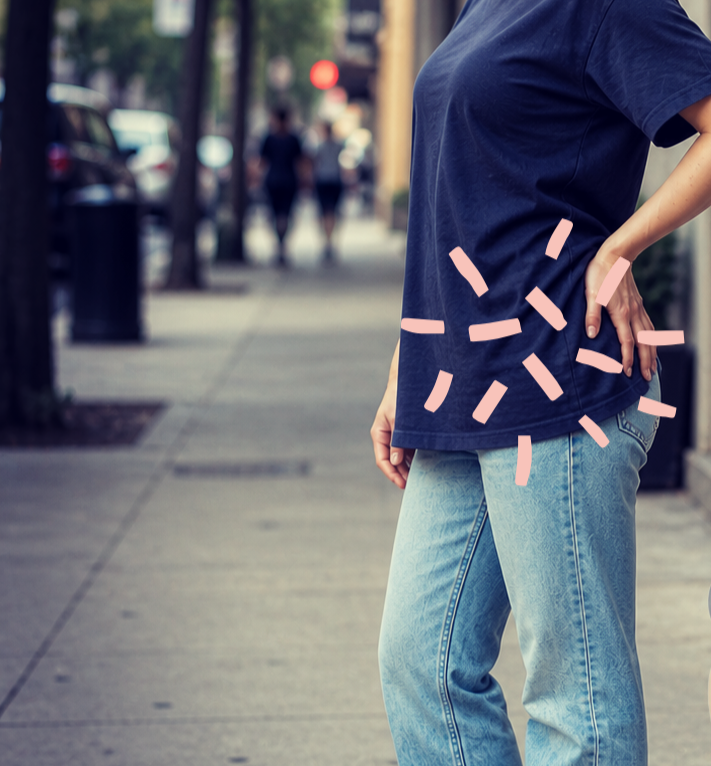
And maybe, if you’re honest, you’ve also noticed something else—a soft gathering around your waist. A place that seems to hold on, no matter what you do.
You stretch.
You move.
You try to be “good” with your body. And still—these things linger. It feels a little unfair, doesn’t it?
I used to think the answer was somewhere outside of me.
A better stretch.
A stronger core.
A more disciplined version of myself.
But the body doesn’t respond well to being managed like a project.
It responds to being understood.
There is one thing I see over and over again.
It’s subtle. Almost invisible.
Most people, when they stand, gently squeeze their glutes.
Not hard.
Not in a way that calls attention to itself.
Just enough—
as if quietly pulling the body together.
It feels supportive.
Like you’re helping yourself.
Like you’re holding something in place.
But here’s the strange part.
That very thing—the one that feels like support—
is often what’s quietly pulling everything out of alignment.
When the glutes draw inward toward each other,
the body narrows.
The pelvis begins to tilt forward.
The abdomen loses its tension network.
The rib cage follows—settling lower and slightly forward in the torso.
What was once a coordinated structure
starts to fold in on itself.
And the result?
That familiar softening around the waist—
what people often call a “muffin top.”
Not just a matter of fat,
but a reflection of how the structure is being held.
Imagine this:
You’re holding a crumpled towel by one end in the air.
Now, with your other hand, support the bottom end.
Then gently push up from below—
or press down from above.
What happens?
The middle of the towel bulges.
That’s what the body does when support isn’t distributed.
When the top presses down
and the bottom pushes up,
the middle has nowhere to go.
So it expands outward.
The body is kind.
It will do whatever it can to keep you moving.
But it pays a price for that kindness.
The lower back begins to carry more than it should.
The hips stop responding the way they’re designed to.
Tension gathers in places that were never meant to hold it.
And sometimes, that tension doesn’t just feel like tightness.
It settles.
Around the waist.
Around the back.
Around the places where the body no longer knows how to distribute effort.
Reorganizing the Structure
There comes a point where you stop trying to “relax” things
and start understanding how they’re meant to work.
This isn’t about softening everything.
It’s about reorganizing support.
Start from the center.
The tailbone and sacrum—this is your anchor.
Not something to tuck under.
Not something to grip around.
But a central point where the hips organize outward.
When the glutes stop pulling inward,
the hips begin to connect from the center—left and right—away from each other.
That changes everything.
From there, the spine has somewhere to go.
Instead of compressing downward into the lower back,
it begins to lengthen upward.
Not by lifting the chest.
Not by forcing posture.
But because the base is finally organized.
The lower back no longer has to hold.
It gains space.
The kind that comes when pressure is no longer trapped there.
And something else happens.
The direction of force reverses.
Instead of: top pressing down and bottom pushing up, the body begins to distribute load through the structure.
The spine lengthens.
The rib cage settles into place.
The abdomen regains tension—not by tightening, but by reconnecting.
That “muffin top”?
It’s not just about what you see.
It’s about where the pressure goes.
When the system reorganizes,
that outward bulge no longer has the same reason to exist.
Because the middle is no longer being squeezed from both ends.
This isn’t dramatic.
But it is precise.
You may feel:
the back of the hips widens
the sacrum settles as a central anchor
the spine lightly lengthens
the lower back quiet down
And it all because you stopped compressing the system.
This is what support actually feels like.
Not tight.
Not held.
Organized.
From here, everything you do—standing, walking, sitting—
begins to reinforce this pattern.
Step by step, you just need to start from the right place.
The center.
And let the structure do what it was designed to do.
